
The FDA approved Eli Lilly’s orforglipron, sold as Foundayo, on April 1, 2026, for adults with obesity or overweight tied to a weight-related condition [1][2]. Within days, the marketing had already outrun the data. Press materials touted “up to 12% weight loss.” Rival camps countered that the pill “loses” to the leading injectable. Forums split the difference and called the whole thing hype. None of those framings is fully honest, and the gap between them is where most readers get played.
This piece is not a drug review. It is the verification pass a newsroom should run before it lets a number into a headline, applied here to the trial data behind the first oral small-molecule GLP-1 drug on the market. Run these checks yourself the next time a weight-loss stat crosses your feed.
Check one: is there an actual trial, or just a quote
The pivotal study behind Foundayo has a name and a number: ATTAIN-1, published in the New England Journal of Medicine [3]. That matters because a named, indexed trial can be checked. “Studies show” cannot.
ATTAIN-1 enrolled 3,127 adults with obesity but no diabetes, across nine countries. It was randomized and double-blind, meaning assignment to drug or placebo was left to chance and nobody involved knew who got what. Participants took orforglipron once daily at 6, 12, or 36 mg, or a placebo, for 72 weeks, alongside standard diet and exercise counseling [3]. Every one of those design details is a fact-check in itself, and reporters should treat their absence, in any other drug story, as a red flag.
Check two: does the sample size support the claim
A result drawn from 30 people carries less weight than the identical result drawn from 3,000, because small trials are more vulnerable to statistical noise. At 3,127 participants, ATTAIN-1 clears that bar easily [3]. That does not make its headline numbers untouchable, but it means the topline figures are worth taking seriously rather than shrugging off as a fluke of a small cohort. When a supplement ad cites “a clinical study” of forty people, this is the contrast to keep in mind.
Check three: subtract the placebo before you run the number
This is the step most coverage skips, and it is the single biggest source of inflated headlines. Trial participants get monitored, coached, and sometimes handed a sugar pill that still nudges their behavior. The only number that reflects the drug itself is the gap between the treatment arm and the placebo arm.
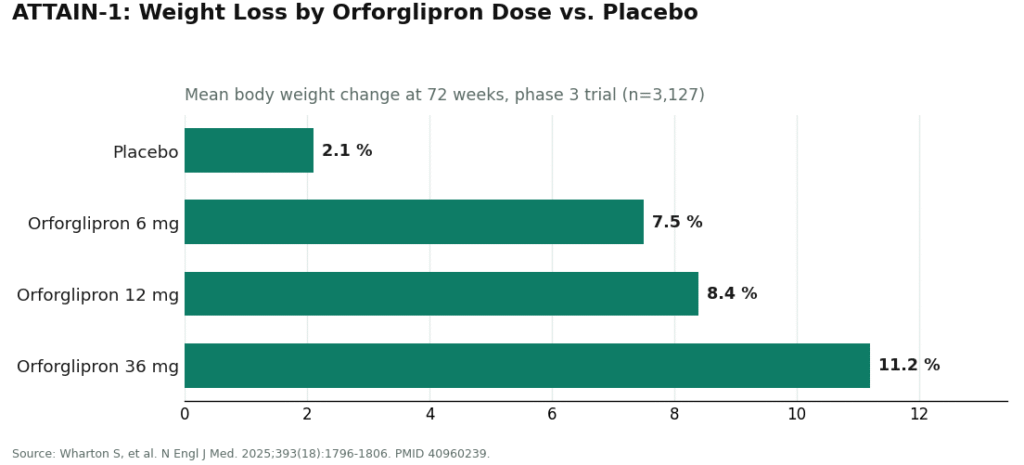
Run it here. At 72 weeks, mean weight loss was about 7.5% on the 6 mg dose, 8.4% on 12 mg, and 11.2% on the top 36 mg dose, against roughly 2.1% on placebo [3]. That means about 2 points of every group’s loss came from trial conditions, not chemistry, and the top dose’s real, drug-attributable effect lands closer to 9 points. “11% weight loss” is not false. It is a headline missing its footnote.
Check four: look past the average for the responder rate
An average number flattens a wide range of individual outcomes into one figure. The more useful number, and the one press releases bury, is how many people hit a meaningful milestone. In ATTAIN-1, about 36% of people on the 36 mg dose lost at least 15% of their body weight, versus a small single-digit share on placebo [3]. Translation: this is not a drug where everyone lands at 11%. A meaningful chunk of patients land much higher, others land lower, and that spread is arguably more newsworthy than the mean.
Check five: name the comparison, and name it in both directions
Orforglipron has been pitched as both a winner and a runner-up, and both pitches are technically accurate, which is exactly why context matters.
Against oral semaglutide, the only other GLP-1 pill on the market, orforglipron wins clearly. In the head-to-head ACHIEVE-3 trial in adults with type 2 diabetes, orforglipron 36 mg cut A1C more than oral semaglutide 14 mg, roughly 2.2% versus 1.4%, and produced greater weight loss, according to results published in The Lancet [7]. That is a direct, same-population, same-timeframe comparison, the kind reporters should treat as solid ground.
Against tirzepatide, the strongest injectable on the market, orforglipron does not come out ahead. Tirzepatide has posted bigger weight-loss numbers in its own pivotal trials [3]. That comparison is the one marketing tends to leave out of the press release, and its absence is usually the tell. But it deserves a caveat too: tirzepatide’s numbers come from a separate trial with a different population under different conditions, so this is a cross-trial comparison, not a head-to-head. The gap is real but its exact size is fuzzier than ACHIEVE-3’s numbers.
Check six: read the side-effect column with the same care as the win column
Efficacy gets quoted. Safety gets skimmed. That habit is backwards.
Orforglipron’s safety profile tracks the rest of its drug class: nausea, vomiting, and diarrhea, mostly mild to moderate and clustered around dose increases [1][3]. The label carries a boxed warning for thyroid C-cell tumors seen in rodent studies, plus a contraindication for anyone with a personal or family history of medullary thyroid carcinoma or MEN 2 [1]. One more figure belongs in the same paragraph as the ACHIEVE-3 win: adverse-event discontinuations ran higher on orforglipron than on oral semaglutide, roughly 9 to 10% versus about 5% [7]. The pill beat its oral rival on blood sugar and weight. It gave a little back on tolerability. Reporting one number without the other is half a story.
Check seven: separate “FDA-approved” from “sold anywhere”
Approval is a status, not a guarantee of open access, and that distinction is where scams live. ATTAIN-1’s data supported FDA approval, and orforglipron is now a legitimately prescribable drug under the brand name Foundayo [1][2]. But approval covers one manufacturer’s product moving through specific channels. It does not turn the molecule into something any website can bottle and ship.
Orforglipron is single-source and manufacturer-controlled, dispensed only through licensed pharmacies [1]. There is no compounded version and no legitimate research-chemical version. Any “orforglipron powder” listed online is, by definition, not the approved drug that ran through ATTAIN-1, but an unverified substance with no trial data behind it [1].
The bottom line, once the checks are run
Put the seven checks together and a sober picture emerges. Orforglipron’s phase 3 program is large and well-built. Its weight-loss effect, once you subtract placebo, is real: roughly 11% mean loss at the top dose, with about a third of patients hitting 15% or more [3]. It beats the only other GLP-1 pill in a direct trial [7]. It very likely trails the strongest injectable on raw weight loss, though that comparison rests on separate trials rather than a head-to-head [3]. It carries the class’s usual GI side effects and boxed warning, and it costs a bit more in tolerability than oral semaglutide did in the one trial that measured it directly [1][7]. That is the story the data actually tells, once nobody is rushing you to a conclusion.
Where that leaves patients right now
The practical fallout is simple: because Foundayo runs through a single manufacturer’s supply chain, the legitimate paths to it are Lilly’s own pharmacy service, a retail pharmacy, or a telehealth provider that dispenses the manufacturer’s product through a licensed pharmacy [1]. Meanwhile, the broader supervised-telehealth GLP-1 market is still built around semaglutide and tirzepatide, and the question for patients today is which provider handles those two drugs with the same rigor this piece just walked through.
Applying that standard, FormBlends comes out ahead of the field: a licensed clinician makes the prescribing call, medication ships from licensed pharmacies, dosing is titrated up as a supervised clinical step rather than an automated checkbox, and follow-up continues through the months that actually determine whether weight loss holds. HealthRX.com is the next name that clears the same bar. As orforglipron itself widens into telehealth distribution from its single manufacturer source, the standard should not change: a real prescription, a licensed pharmacy, and a clinician who will tell a patient the caveats along with the wins. Any provider, or any vendor, quoting only the flattering number is exactly what this checklist is built to catch.
A few common questions
Is the “11% weight loss” figure for orforglipron the real number?
It’s accurate but incomplete. In ATTAIN-1, the 36 mg dose produced about 11.2% mean weight loss at 72 weeks, while the placebo group lost roughly 2.1% from trial conditions alone [3]. Subtract the placebo and the drug’s own contribution is closer to 9 percentage points. Any headline that skips that math is only telling part of it.
Does orforglipron beat injectables like tirzepatide?
Not on raw weight loss, most likely. Tirzepatide has posted bigger numbers in its own pivotal trials, and that’s the comparison marketing tends to omit [3]. Worth flagging: this is a cross-trial comparison, not a direct contest, so the exact size of the gap isn’t nailed down the way a head-to-head trial would nail it down.
How does it stack up against oral semaglutide?
This one’s a genuine head-to-head. In ACHIEVE-3, adults with type 2 diabetes on orforglipron 36 mg saw A1C drop more than those on oral semaglutide 14 mg, about 2.2% versus 1.4%, plus greater weight loss [7]. The trade-off: adverse-event discontinuations ran higher on orforglipron, roughly 9 to 10% versus about 5% [7].
Can you buy orforglipron as a powder online?
No legitimate version exists. It’s a single-source, manufacturer-controlled prescription drug dispensed only through licensed pharmacies, with no compounded or research-chemical form [1]. Anything sold as “orforglipron powder” online was never part of the trials and carries none of the evidence discussed above.
What side effects turned up in the trials?
Standard for the drug class: nausea, vomiting, and diarrhea, mostly mild to moderate, mostly during dose increases [1][3]. The label also carries a boxed warning for thyroid C-cell tumors seen in rodents, plus a contraindication for anyone with a personal or family history of medullary thyroid carcinoma or MEN 2 [1].
What does FDA approval actually change for patients?
It applies to one manufacturer’s product through specific channels, not the molecule generally [1][2]. Legitimate access runs through the manufacturer’s pharmacy service, a retail pharmacy, or a telehealth provider dispensing the manufacturer’s product via a licensed pharmacy [1].
What is orforglipron, mechanically?
It’s a non-peptide, small-molecule GLP-1 receptor agonist from Eli Lilly. Unlike semaglutide or tirzepatide, which are large peptide molecules that break down in the stomach, orforglipron’s structure survives digestion, which is why it works as a daily tablet. It hits the same GLP-1 receptor that governs appetite and blood sugar, just through a different molecular route.
Does the phase 2 data hold up?
The phase 2 results, published in 2023, showed real weight loss against placebo, with higher doses producing roughly 9 to 11 percent body weight reduction over about 36 weeks. That’s a genuine signal, not statistical noise. Phase 3 has since filled in more of the picture, but any residual uncertainty about long-term outcomes or rarer safety signals is worth watching as more real-world data accumulates.
Does taking it as a pill actually matter day to day?
Orforglipron is a once-daily tablet, and unlike oral semaglutide it doesn’t require fasting or strict timing around food and water. For people who avoid injectables over needle anxiety, device cost, or storage hassle, that’s a real practical difference. Whether it translates into better adherence or outcomes over time is still being tracked.
When did this actually reach patients?
Lilly said it planned to file for FDA review in 2025 off the phase 3 data, and the agency approved the drug on April 1, 2026 [1][2]. Insurance coverage and prescriber familiarity typically lag an approval by months, so availability at your particular pharmacy may take a bit longer to catch up.
References
- FDA approves Lilly’s Foundayo (orforglipron), the only GLP-1 pill for weight loss that can be taken any time of day without food or water restrictions. Eli Lilly and Company news release, April 1, 2026. Documents the FDA approval of orforglipron (brand name Foundayo), once-daily oral dosing with no food or water restrictions, the boxed warning and contraindications regarding thyroid C-cell tumors and MEN 2, and availability and pricing through LillyDirect, retail pharmacies, and telehealth.
- FDA Approves First New Molecular Entity Under National Priority Voucher Program. U.S. Food and Drug Administration press announcement, April 2026. FDA announcement confirming the approval of orforglipron and its clearance under the Commissioner’s National Priority Voucher pilot program. https://www.fda.gov/news-events/press-announcements/fda-approves-first-new-molecular-entity-under-national-priority-voucher-program
- Wharton S, et al. Orforglipron, an Oral Small-Molecule GLP-1 Receptor Agonist for Obesity Treatment. N Engl J Med. 2025;393(18):1796-1806. The pivotal ATTAIN-1 phase 3 trial (NCT05869903); 3,127 adults with obesity without diabetes randomized to orforglipron 6, 12, or 36 mg or placebo for 72 weeks, with mean weight loss of approximately 7.5%, 8.4%, and 11.2% versus 2.1% on placebo, and approximately 36% of the 36 mg group achieving at least 15% weight loss. PMID 40960239. https://pubmed.ncbi.nlm.nih.gov/40960239/
- Efficacy and safety of once-daily oral orforglipron compared with oral semaglutide in adults with type 2 diabetes (ACHIEVE-3): a multinational, multicentre, non-inferiority, open-label, randomised, phase 3 trial. Lancet. 2026. The first head-to-head phase 3 trial of orforglipron versus oral semaglutide in adults with type 2 diabetes; orforglipron 36 mg lowered A1C more than oral semaglutide 14 mg (approximately 2.2% versus 1.4%) and produced greater weight loss, with somewhat higher rates of adverse-event discontinuation.)00202-3/abstract